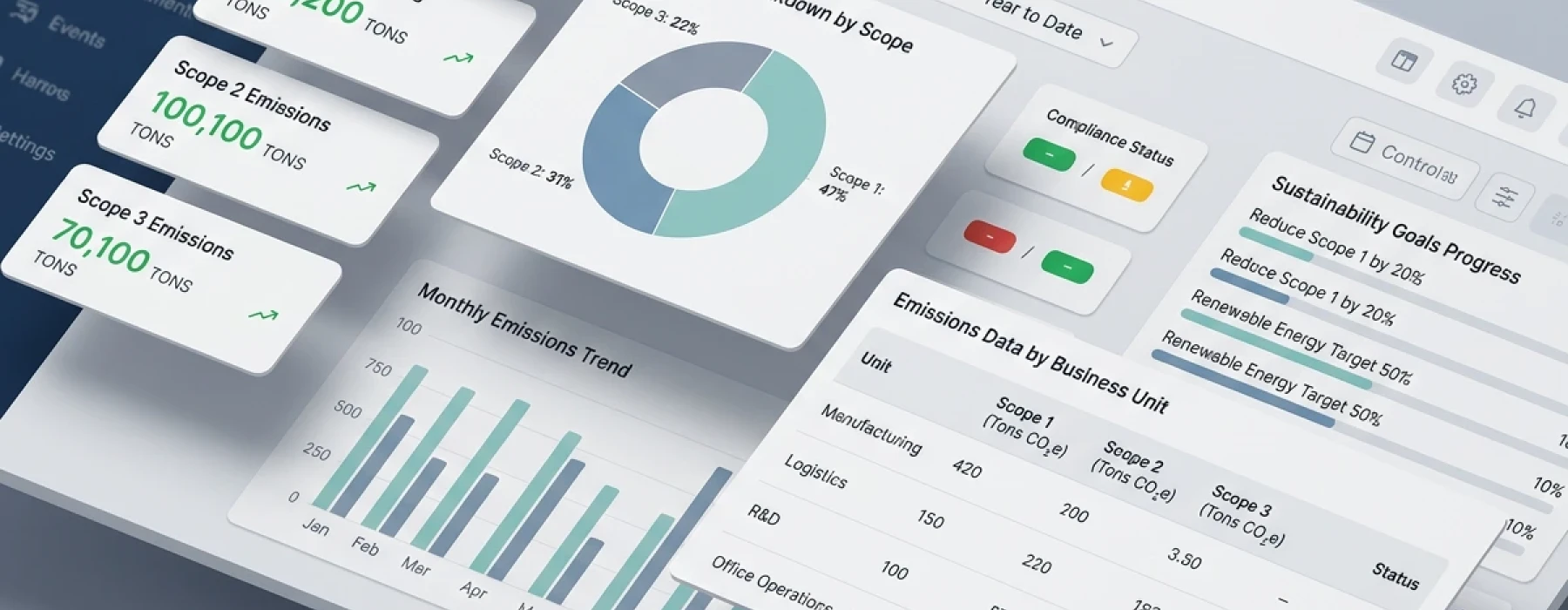
Carbon accounting software helps companies replace scattered spreadsheets and manual data collection with a structured basis for climate management. With Substain, you can collect CO₂e data centrally, calculate greenhouse gas emissions across Scope 1, 2 and relevant Scope 3 categories, identify hotspots and prepare results for sustainability reporting. Uploads, manual entry and API connections help create a consistent foundation for your corporate carbon footprint, reporting requirements and climate action.
Substain combines a flexible carbon accounting platform with expert support from ConClimate and can grow from a first CCF to Product Carbon Footprints, Life Cycle Assessment and wider ESG management.
See how Substain can structure your carbon accounting
Carbon Accounting Software for Structured, Traceable Carbon Management
Carbon accounting becomes difficult when information is spread across locations, departments, suppliers and file versions. Financial accounting software is built around repeatable processes; carbon data needs comparable structure.
Substain maps companies, locations and responsibilities in one environment. Data can be uploaded, entered in the browser or imported via API. Stored emission factors can be used and company-specific factors added where required. Versioning and an audit trail make data statuses transparent, from estimates to audited information. This supports consistent carbon accounting reporting without increasingly complex spreadsheets.
How Carbon Accounting Software Works: From Raw Data to Report
Professional carbon accounting follows a repeatable process. Carbon accounting software standardises the workflow while keeping methodological decisions visible.
01
Define boundaries
Clarify which companies, sites and activities belong to the inventory.
02
Identify emission sources
Map Scope 1, Scope 2 and relevant Scope 3 categories.
03
Collect activity data
Gather energy, fuel, transport, purchasing, travel and other relevant information.
04
Assign emission factors
Convert activity data into carbon emissions using suitable factors and documented assumptions.
05
Calculate the footprint
Consolidate results across entities, locations, scopes and categories.
06
Review data quality
Check gaps, estimates, ownership and unusual results.
07
Analyse hotspots
Identify the sources and categories driving the corporate carbon footprint.
08
Set targets and measures
Translate results into reduction priorities and, where relevant, science based targets.
09
Report and update
Reuse the structured dataset for management, sustainability reporting and annual calculations.
The GHG Protocol provides widely used requirements and guidance for corporate greenhouse gas inventories and distinguishes Scope 1, 2 and 3 emissions. A structured process makes this methodology practical in day-to-day data management.
Scope 1, 2 and 3: Better Data Where Complexity Is Highest
SCOPE 1
Scope 1 includes direct emissions from sources owned or controlled by the company.
SCOPE 2
Scope 2 covers indirect emissions from purchased energy such as electricity, heat or steam.
SCOPE 3
Scope 3 includes other indirect emissions along the value chain, for example purchased goods, transport, business travel and the use of sold products.
Scope 3 is often where carbon management software delivers the greatest operational benefit because categories depend on different teams, supplier information and varying data quality. Substain structures responsibilities and provides detailed Scope 3 analyses by category.
Some calculations may initially rely on estimates or secondary data. Making these differences visible helps teams improve data quality over time and keep calculations reproducible.
Companies building their first inventory can start with the Corporate Carbon Footprint module and extend the data structure as requirements grow.
From Corporate Footprint to Product Carbon Footprint and LCA
A corporate carbon footprint shows where greenhouse gas emissions occur across the organisation. Customer requests, tenders and product decisions may require a more granular view.
CCF
→
PCF
→
LCA
→
Reporting & Targets
Substain connects corporate carbon management with Product Carbon Footprint calculations. PCF data can identify emissions along a product life cycle, reveal reduction opportunities and support customer, tender or product decisions.
The Life Cycle Assessment module can extend the analysis beyond CO₂e to additional environmental impacts. This helps avoid separate data silos and creates one sustainability management platform for corporate, product and life-cycle perspectives.
What Should Carbon Accounting Software Deliver?
A software evaluation should start with your company structure, data sources, reporting frameworks, resources and future use cases. The right platform should simplify recurring work without hiding the methodology.
| Typical challenge |
What to look for |
| Multiple files and versions |
Central data collection and responsibilities |
| Manual consolidation |
Uploads, manual entry and API integration |
| Limited traceability |
Versioning, audit trail and transparent data statuses |
| Complex Scope 3 data |
Category-level analysis and flexible structures |
| Disconnected calculations |
Reusable data for CCF, PCF and ESG use cases |
| Reporting effort |
Reports and exports for different requirements |
| Targets without follow-up |
Connection between footprint, goals and measures |
Substain supports these workflows through structured data collection, flexible corporate structures, Scope 3 analysis, interactive reporting, exports and target and measure management.
Also check whether the provider offers expert support. Regulatory requirements and methodology cannot always be solved by software alone. Setup, boundaries, assumptions and data quality require informed decisions.
From Regulatory Compliance to Better Sustainability Reporting
Carbon data feeds into customer questionnaires, ESG processes and regulatory compliance. Different reporting requirements may ask for similar underlying information in different formats.
Carbon accounting software helps maintain one consistent dataset and reuse it across reporting frameworks. Substain provides interactive reports as well as PDF and Excel exports and connects carbon information with wider ESG data management.
Carbon accounting software does not determine which regulatory requirements apply to your organisation. It gives responsible teams a more reliable basis for meeting applicable requirements and stakeholder requests.
For companies working with science based targets, consistent baseline and follow-up inventories are also essential for tracking progress. The Science Based Targets initiative defines specific criteria and methodologies companies must follow if they want targets to be considered science-based.
Why Move Beyond Excel for Recurring Carbon Accounting?
Excel can work for an initial footprint Once several sites, periods and data owners are involved, manual data processes become harder to control.
Software supports recurring processes Carbon accounting software reduces repeated requests, simplifies consolidation and makes annual updates easier to reproduce.
Teams can analyse results by entity or category and reuse the same data for reports and measures. For medium-sized companies with limited resources, digital workflows free sustainability teams to spend more time interpreting results and prioritising actions.
Carbon Management in Practice: TESSLOFF and Köster
TESSLOFF
At TESSLOFF, ConClimate supported a complete CCF with particular attention to different paper types. Product Carbon Footprints added a more detailed view at book level, while Substain centralised the data and enabled automated ESG KPI calculations. Specific emission factors were also developed for the printing process, providing a stronger basis for decisions on paper and printing partners.
Read the TESSLOFF case study
KÖSTER
At Köster, a large number of construction projects, materials and Scope 3 data points had to be consolidated. ConClimate supported the development of a complete corporate footprint and a project-specific PCF calculation approach. Substain provides the digital structure for collecting and evaluating the relevant CO₂ data.
Read the Köster case study
These cases show why carbon accounting software should adapt to the company rather than forcing every organisation into the same template.
Software Plus Expert Support for Practical Climate Action
Carbon accounting involves more than collecting numbers. Teams need to define boundaries, select appropriate data, assess gaps and translate results into decisions.
Substain combines software with ConClimate’s carbon and ESG expertise. Support can cover setup, data structure, methodology and practical application – especially when a company establishes its process or extends an existing footprint. ConClimate also supports companies with topics such as Scope 3 categories, data quality, emission factors and calculation logic.
The aim is a system that works in everyday operations: clear responsibilities, a central data basis and a repeatable process. Targets and measures can then be linked to CCF results, moving from calculation to active carbon management.
Learn more about Substain
Discuss how Substain can fit your data structure and carbon management process.
Explore Substain
FAQ: Carbon Accounting Software
What is carbon accounting software?
Carbon accounting software is a digital solution for collecting activity data, calculating greenhouse gas emissions and managing carbon information across a company. Good carbon accounting software can support Scope 1, 2 and 3 calculations, analysis, reporting and target tracking.
How much does carbon accounting software cost?
Costs depend on company size, entities, modules, integrations and expert support. Compare total implementation and operating requirements, not only the licence price.
How long does implementation take?
Implementation depends on organisational structure, data availability, integrations and existing processes. Clear responsibilities and defined system boundaries make setup more efficient.
Can Substain integrate with ERP systems?
Yes. Substain supports API connections to systems such as ERP, CRM and order management. Data can also be added through upload templates or manual entry.
How are emission factors handled?
Substain provides stored emission factors and allows companies to add their own factors where needed. Relevant sources, assumptions and data quality should be defined during setup so calculations remain transparent and reproducible.
Can the software support audits or assurance processes?
Substain includes versioning and an audit trail that make data statuses and changes more transparent. Whether specific assurance requirements are met should be assessed against the relevant reporting framework and audit scope.